
Fragments #6
legends | questions for a wounded world | aurora | creativity | bell hooks | community

Thank you for reading Field Notes, which explores interdependence, human and non-human nature, history, inner life, poetry, creativity, spirituality, community, civic belonging, and the ways we make a life. This instalment is Fragments; a regular gathering of underlinings, links, and the things I’m turning over in my mind. I also write a longer Village View instalment, roughly every two weeks.
A story I’ve been thinking about
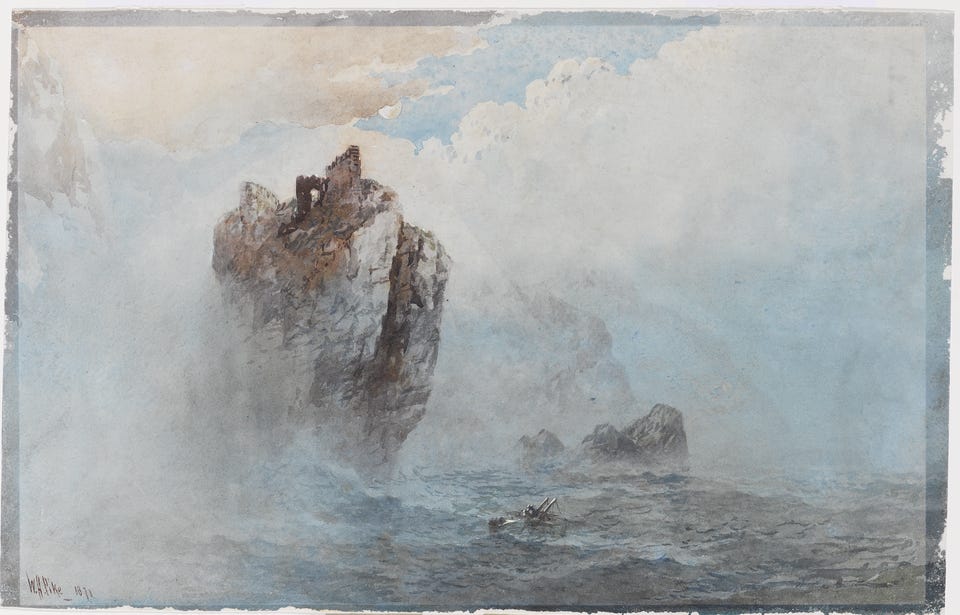
On the north Cornwall coast, an hour or so west of where we live, the ruins of Tintagel castle cling to the rocky cliffs. It is a place that has been shaped by time, sea mist and mystery, but that will always be known as the place where King Arthur was supposedly conceived and born. It is a threshold of land and sea, history and legend.
In one Arthurian story, the Fisher King was the last in a long line of guardians of the Holy Grail and was protector and embodiment of the land. But he suffers a wound that renders him unable to properly move or rule. His land falls into ruin and becomes a barren wasteland, but still the king spends his days fishing on a river; perhaps a symbol of a lingering hope. Despite being a king and despite possessing the Grail, he cannot heal himself — he and his land will remain in decline until a person arrives who will ask him the right question. He longs to be healed and to see change in the land but he does not know when or by who healing will arrive. He does not know what is needed for life to begin again.
Accounts differ, but in most, a knight called Perceval arrives who wants to fix things but knows only force and conquest. He fails to ask the right question: What ails thee, O King? Because of his lack of understanding that compassion and enquiry are paths to healing, the curse remains.
This legend often blows through my mind, carried from the Atlantic edge when I watch the news. I see that the curse remains. Our leadership is broken, our world is suffering ecologically, socially, spiritually — and force, conquest, moonshots, money, power will not bring healing.
In local politics, and in international development, I saw how easy it could be to miss what was needed for real healing, assuming perhaps it was too basic for clever-sounding projects: dropping defences and pretences, really being with another person, asking them and ourselves the right questions with genuine curiosity and compassion, and deeply listening to what those questions create space for. Good and meaningful questions can themselves be forms of power and healing.
The Arthurian story has been in my mind, and at first it made me think about the inadequacy of purely technocratic solutions — contemporary responses to crises (climate, political, social) seem to mirror Perceval’s failure: we arrive with solutions before we’ve recognised the real questions. AI fixes, carbon capture, “innovation”, “growth”, and other tools seem to get deployed without prior honest and compassionate questions. We can capture carbon, but what is the wound beneath the symptom that tool it is trying to fix?
The longer I’ve sat with the story though, the more it struck me that the King’s wound must have been very serious for him not to be able to move or rule and for the land to fall to ruin, and yet the wound is never named.
Perhaps we’re a civilisation that is getting sick and can’t heal because we won’t name or don’t know what actually ails us. We rightly try to treat symptoms (like polarisation, loneliness, depleted soils, ecosystem collapse) but don’t ask deeper questions about what we’ve lost relationally, spiritually, communally, and so on. I suspect one collective wound is disconnection — from each other, and from our stories and our places and their human and non-human life, all of which tether us to the wider world, and to the network of every living thing.
It strikes me too how the king, despite his power and status, cannot heal himself or the land. He must wait for the gift of another for healing. Wholeness will come through attentive and curious relationship.
When I despair at global leaders who look busy and bend words until they become meaningless and who seem to be making the world’s wounds worse, I try to remember that Perceval’s impulse toward action and force is less effective than the relational act of asking “what ails thee?” — and I try to remember that good, meaningful, compassionate questions, and subsequent deep listening, and the space this can open up, are tools we can all deploy in this wounded world.
Reading and links
🎨 Early human creativity: I find creativity fascinating. This BBC story details how a cave painting of red claw hand in Sulawesi could rewrite the timeline of human creativity.
“Cave art is seen as a key marker of when humans began to think in truly abstract, symbolic ways – the kind of imagination that underpins language, religion and science.”
“Over the past decade, a series of discoveries on Sulawesi has overturned the old idea that art and abstract thinking in our species burst suddenly into life in Ice Age Europe and spread from there.” The print shows a “much deeper and more widespread story of creativity”.
🌌 Lights in the sky: This week, looking north one night, we saw the Aurora Borealis. It’s the third time we’ve unexpectedly seen it here, in Devon, and each time is a wonder; a reminder that we were born from and still live amongst stars.
In this Marginalian piece, Maria Popova traces human efforts to observe and understand the phenomenon. The end of her piece concludes that this generational seeking serves to heighten the wonder of the Aurora:
“I feel that the science of it — this work of immense forces across immense distances, this work of the human imagination across a lineage of minds thirsting for truth — only magnifies the magic of the celestial spectacle. Suddenly, we are plunged into a dazzling awareness of our cosmic origins and our connection to one another, each of us a link in the unbroken chain of time going back…to the first human animal who looked up at the storm of color and was stilled with awe, back to the Big Bang that produced the particles roiling in the night sky. Whenever we gasp at an aurora, our lungs inhale molecules of air made of atoms forged in the first stars, and we are left wonder-smitten by reality…”
🐾 Cats: annoying since forever. This image in the Smithsonian made me chuckle in recognition — a cat left paw prints on medieval manuscript 500 years ago, after its author left carefully-lettered ink to dry. As a former cat-owner, I can confirm that the tiny beasts have not changed. And in a digital age, I wonder what records of creativity-in-process will look like in 500 years time?
Underlinings
“True hospitality is marked by an open response to the dignity of each and every person. Henri Nouwen has described it as receiving the stranger on his own terms, and asserts that it can be offered only by those who 'have found the center of their lives in their own hearts'” — Dakota: A Spiritual Geography, by Kathleen Norris
“I dreamed about a culture of belonging. I still dream that dream. I contemplate what our lives would be like if we knew how to cultivate awareness, to live mindfully, peacefully; if we learned habits of being that would bring us closer together, that would help us build beloved community.” — bell hooks, Belonging: A Culture of Place
“Anarchism and gift exchange share the assumption that it is not when a part of the self is inhibited and restrained, but when a part of the self is given away, that community appears.” — Lewis Hyde, The Gift: How the Creative Spirit Transforms the World
“And do you know another thing, Arthur? Life is too bitter already, without territories and wars and noble feuds.” — TH White, The Once and Future King. (Directing this, if I could, to certain current world leaders who only seem to want more territory, more war, more bitterness)
Thanks for reading. If you’d like to support my work please consider liking, commenting, sharing, subscribing, or becoming a paid subscriber for less than the cost of a coffee each month. Thank you if you already do!
Elizabeth x
PS - you can read some other recent posts here:


